

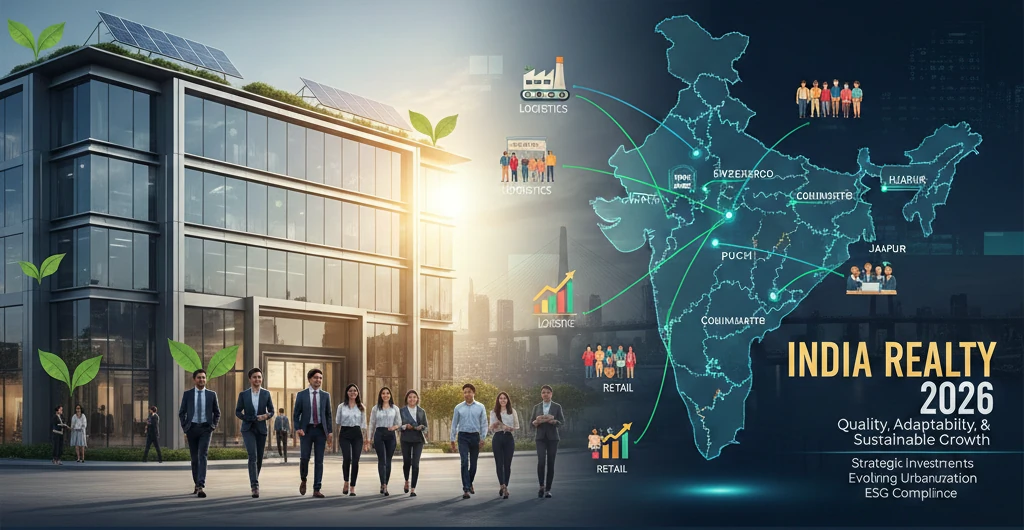
The Indian commercial real estate outlook for 2026 indicates a timeline of shifts and opportunities for builders and shareholders. With the country's finances set for sustained development, changing work habits, and developing urban areas, the industry is approaching a phase that calls for strategic business thinking. Understanding the trends that shape this market is essential for investors seeking to make accurate moves in the coming years, especially for those reviewing commercial property for sale in India’s biggest and upcoming business centers.
1. Commercial Property evolves towards superiority and adaptability
The commercial sector continues to be the core of India’s industrial real estate market, yet its nature is transforming. Demand is driven by A-grade properties throughout the leading seven cities, including Bengaluru, Hyderabad, Gurugram, and Pune, remaining to dominate occupancy. Major tenants are combining businesses into smaller, better-quality buildings that offer innovative flooring, robust digital networks, and stable power and water infrastructures.
The overall demand hasn't decreased to the extent expected from hybrid work. Rather, it has changed inclinations. Companies are looking for commercial spaces that encourage cooperation and team interaction rather than packed desks. Developers who offer flexible layouts, wellness-centric design, and futuristic building systems are better positioned to maintain occupancy and rental stability through 2026.
2. Worldwide power centers drive sustained leasing
One of the primary economic factors is the proliferation of global power centers. Multinational firms continue to expand their operations in India across technology, finance, engineering, and research sectors. These tenants typically sign long-term leases and prefer commercial-grade developments. Their existence ensures steady cash flows and less risk of vacancy, which is particularly appealing for long-term investors. This stability directly influences demand for commercial property for sale that offers predictable leasing profiles
Tier two cities like Coimbatore, Kochi, Indore, & Jaipur are also starting to attract discerning global renters. Although revenues remain limited, initial movers with the suitable goods and neighborhood collaborations may profit through reduced property costs and rising employment opportunities.
3. Logistics and commercial assets gain strategic importance
The transportation and commercial sector is anticipated to witness some of the greatest expansion through 2026. The rise of e-commerce, regulation of distribution networks, and government expenditures on routes, docks, and designated logistic corridors are transforming demand. Tenants are looking for large, compliant facilities close to consumption centers rather than scattered warehouses.
Developers are responding with planned logistics parks offering standardized sheds, fire safety systems, and room for automation. For investors, these assets offer relatively stable yields and lower exposure to cyclical office demand. However, land acquisition, zoning clarity, and execution discipline remain critical success factors.
4. Retail real estate favors experience over expansion
Physical retail in India has recovered steadily, but growth is selective. Large destination malls in dense urban catchments are performing better than smaller standalone centers. Brands are focusing on fewer stores with higher throughput, supported by strong food, entertainment, and leisure offerings.
For developers, the lesson is restraint. New supply should be thoughtfully linked with demand in the area, income rates, and unique layouts. Mixed-use developments that incorporate commercial with offices, hotels, or residential components are placed more effectively to minimize risk and sustain visitors throughout the week.
5. Ecology emerges as a significant driver
Ecological performance is no more a secondary factor. Tenants and investors are raising their focus to energy efficiency, water management, and lifecycle costs. Developments with trustworthy green ratings often have higher occupancy and better tenant stability.
By 2027, environmental accountability is expected to affect financing conditions as well. Lenders and private shareholder funds are progressively connecting liquidity to ecological standards. Developers who integrate sustainable design from the development stage, rather than considering it as an additional feature, shall be more accurately compatible with consumer needs and regulatory standards.
Also Read: 40 Best Office Colour Combinations | Vastu Tips
6. Capital flows turn more selective and disciplined
Financial capital stays active in Indian commercial real estate, but financing standards are tightening. Investors are emphasizing completed or nearly finished properties with prominent rental exposure. Platforms with effective management, clear reporting, & skilled employees are captivating the bulk of funding.
Collaborations between local developers and international investors persist to influence the market. These collaborations bring not only funds but also expertise in layout, regulation, and resource management. Independent developers who lack accessibility to such financial resources may find it difficult to survive until they gain expertise.
7. Regulatory clarity supports long-term planning
Regulations like RERA and the growth of real estate investment trusts (REIT) have increased accountability and investor trust. While legal methods still differ by state, the broader direction promotes regulation and professional leadership. By 2026, REITs are projected to perform a greater responsibility in reusing equity, presenting developers an exit route and investors a liquid view to resilient assets.
Looking ahead
The Indian commercial property market is not entering a phase of unchecked expansion. Instead, it is moving toward maturity, where quality, compliance, and operational strength matter more than speed. Developers who focus on durable assets and investors who align capital with long-term demand drivers are likely to benefit. This strategy will ultimately determine whether a commercial property for sale maintains value over the upcoming cycle.
Indian Commercial Real Estate Outlook 2026 is therefore less about speculation and more about execution. The opportunity remains significant, but it favors those who understand that the next cycle will reward patience, precision, and a clear view of how people and businesses actually use space.
Posted By

Ruchi Mane
info@houssed.com
Ruchi Mane is the Senior Editor at Houssed, leading the platform’s real estate news coverage. She tracks trends in India’s luxury property market while overseeing editorial strategy, PR outreach, and social media communication.