

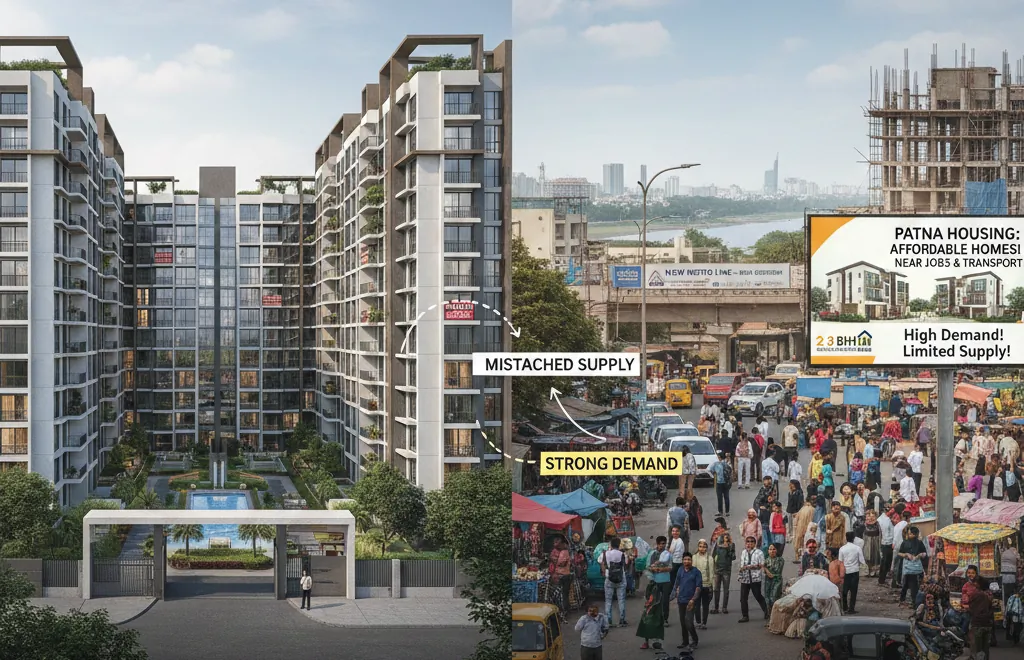
Patna, the capital of Bihar, one of India’s rapidly advancing Tier-2 cities, has an interesting paradox for real estate. On one hand, there's a growing demand for real estate, but on the other, there's a vast inventory of unsold and vacant flats. This scenario is beyond just a local phenomenon and has implications on pricing, investment, rentals, and the overall growth of the city in the long run.
1. Location & Supply: Misaligned With Buyer Needs
One of the biggest causes of empty flats isn’t demand itself; it’s the location and the type of homes that are being built. Due to the higher margin, developers often target upmarket, luxury, or mid-priced homes, which causes a gap in truly affordable housing. A national trend has shown a shifting focus of developers from entry-level housing units to premium launches.
However, the affordable premium and larger flats, ranging from 3 & 4 BHK, with amenities like a gym, garden, and security, are still the core demand rather than traditional compact homes. Demand for such flats is strong, appealing to first-time buyers, young professionals, and growing families looking for additional space without breaking the budget.
Meanwhile, new projects frequently appear on the peripheries or far-out suburbs like Bihta, where future growth is anticipated but where infrastructure and jobs haven’t yet caught up fully.
Read Also: How Social Media Has Made Vastu Anxiety Worse for Homebuyers
2. So Why Are There So Many Empty Flats?
Demand is not always proportional to sales of each flat.
A. Mismatch Between Supply and Buyer Needs
Developers have initiated many premium and luxury projects, expecting upward-moving demand, but many buyers still seek affordability or functional requirements. There’s a growing gap between what’s built and what mass buyers want.
For instance, a 3-4 BHK luxury flat may remain vacant while a well-priced 2 BHK in a functional location gets sold out quickly.
B. Oversupply in Certain Areas
Developers who prioritized large units or specific localities (such as Boring Road) ended up with inventory that doesn’t match actual buyer budgets or preferences, particularly among first-time buyers and young professionals.
C. Price & Affordability Constraints
While many people choose to buy, rising property prices and economic conditions have forced buyers to wait for better offers or price adjustments. for better deals or revised prices. Even in Patna, property sales slowed in early 2025, echoing broader national trends of cautious consumer sentiment.
D. Infrastructure Development Timelines
Infrastructure projects such as new expressways or satellite town expansions (e.g., toward Bihta) influence where people want to buy. If basic connectivity is delayed, newly built flats in those zones stay empty longer.
3. Local Market Dynamics in Patna
Hot Areas With High Demand
Boring Road & Bailey Road: Established buyers who are willing to pay for a lifestyle are drawn to premium locations close to transportation hubs. This investment-led purchase behaviour distorts occupancy data; homes may be “sold” but not lived in.
Danapur & Saguna: Growing residential complexes with better amenities and fair prices.
Bihta Satellite Growth: Emerging as a strategic growth zone due to education centers like IIT, improved roads, and new residential offerings.
Areas With Higher Vacancies
Areas where new developments outpaced actual demand, especially where connectivity and everyday amenities are lacking, see more empty units. A basic rule: better location + infrastructure = lower vacancy.
3. Employment & Urban Dynamics Affect Occupancy Patterns
While the city is expanding in education, healthcare, government services, and connectivity, offering jobs and opportunities, its employment growth isn’t as high or diversified as traditional metro markets like Bangalore or Delhi.
This means:
A significant portion of property owners are investors, not residents. Many buy flats as future investments or for families living elsewhere, particularly in cities where they currently work.
Some properties are held empty for long periods, waiting for capital appreciation rather than immediate occupancy.
This investment-led purchase behaviour skews occupancy data; houses may be “sold” but not lived in.
5. Infrastructure Is Developing but Gradually
Infrastructure like metro corridors, flyovers, and major road expansions drives demand and occupancy. As buyers see value being unlocked (schools, hospitals, retail hubs), they commit to moving into units that earlier didn’t make sense
Some flats will remain unsold or unoccupied until these improvements are completed and connected to the residential housing complex.
6. Government Policies & Market Forces
Regulatory clarity through RERA helps build buyer confidence; however, if enforcement lags, buyers remain alert.
GST and taxation (relevant for developers): Recent court rulings on GST applicability for joint development agreements can add cost pressure and delay launches or sales.
Urban Master Plans: Patna’s Master Plan aims to expand growth zones and satellite towns; timing is crucial. Flat occupancy increases only when living conditions and services keep up.
Read Also: 7 Red Flags in a Sale Agreement You Shouldn’t Ignore
7. Resale Pressure & Quality Concerns
Another less-discussed factor is construction quality and developer image. After inspection, some buyers decide not to occupy units due to delayed deliveries, build quality issues, or lack of community planning.
This contributes to flats being on sale or remaining empty even after purchase.
Final Thoughts
Patna’s empty flats aren’t proof of weak demand; they show structural mismatches. The city does have rising housing demand due to urbanization, a growing middle class, and better job prospects, but it also has:
- Misaligned supply (too many luxury or far-out units)
- Buyer caution due to pricing and economic uncertainty
- Investor-led purchases not occupied yet
- Gradual infrastructure growth
Property markets always have rough patches, and Patna’s is no exception. The imbalance between what’s built and what buyers truly want is creating the “empty flats” phenomenon.
Smart decisions begin with the right information.
Posted By

Siddharth Jangam
info@houssed.com
Siddharth Jangam contributes to the Guides section at Houssed and works as a Digital Media Specialist focused on SEO and social media marketing. He shares insights that help readers understand India’s real estate market and buyer behavior.