

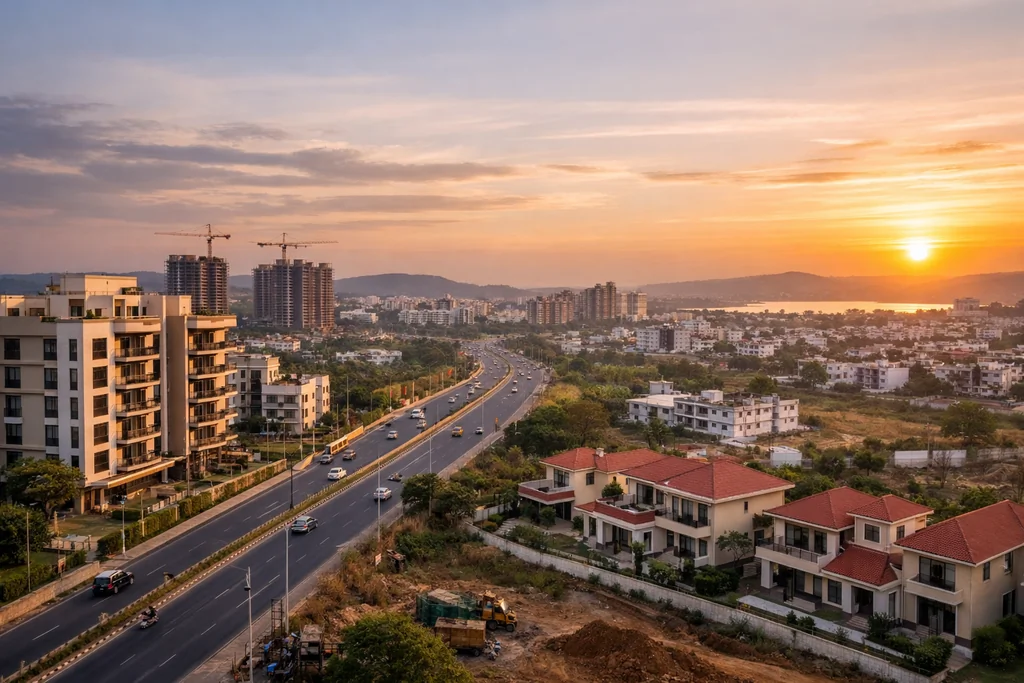
MIHAN impact on Nagpur real estate prices has become one of the most talked-about developments in Maharashtra’s property market. Over the past decade, MIHAN has transformed Nagpur from a Tier-2 city to an expanding business and logistics hub. When large projects bring jobs, roads, and companies, property demand usually follows.
When MIHAN was first announced, land prices in nearby areas were relatively low because the region was still in the process of development. Early investors who bought plots at that stage saw steady appreciation once roads, offices, and commercial spaces started coming up.
Infrastructure = Jobs = Migration = Housing Demand = Price Growth
Areas within a 5–10 km radius of MIHAN saw the earliest price movement. Investors who understood the long-term vision entered early, and now those same locations are considered growth corridors.
Property Prices Before vs After MIHAN
Before MIHAN’s announcement, Nagpur’s real estate prices grew slowly, largely tied to local demand. Most buyers were end-users, not investors.
Before MIHAN (pre-2009 phase):
- Low speculative investment
- Limited luxury or premium housing
- Minimal corporate leasing demand
- Stable but slow appreciation
After MIHAN announcement & early development:
- Land prices near MIHAN zones surged first
- Speculators entered aggressively
- Developers launched township projects
- Plot investments spiked
- Areas Benefiting the Most
The MIHAN impact on Nagpur real estate prices initially appeared strongest in land markets before residential units gained momentum.
Not all parts of Nagpur are gained equally. The strongest appreciation clusters appeared around:
- Wardha Road corridor
- Hingna Road area
- Butibori industrial location
- Khapri and nearby suburbs
These areas benefited because they offered three things investors always chase:
- Proximity to employment hubs
- Infrastructure connectivity
- Availability of developable land
Current Property Price Trends Near MIHAN
The MIHAN impact on Nagpur real estate prices did not cause overnight spikes. Growth has been gradual and development-linked.
- Typical trends observed in MIHAN-influenced zones:
- Plot prices rose first, even before residential projects launched
- Apartments gained value after companies began operations
- Rental demand increased once employees moved closer to work
Localities like Khapri, Wardha Road area, and nearby emerging sectors have seen stronger demand compared to many older parts of Nagpur. This shift shows that buyers today prefer future growth locations instead of only established areas.
Properties within 5 -10 km of MIHAN saw the earliest spikes because buyers anticipated future demand from employees and businesses relocating there.
Commercial vs Residential Impact
MIHAN’s biggest influence wasn’t on homes initially; it was on commercial real estate.
Commercial Market Effects
- Office space demand rose from IT and logistics firms
- Warehousing investments increased
- Industrial plots saw faster price escalation than residential land
This is typical of infrastructure-driven growth cycles. Businesses move first. People follow later.
Residential Market Effects
Residential demand grew in phases:
- Phase 1: Investors buying plots expecting appreciation
- Phase 2: Developers launching housing projects
- Phase 3: Actual residents moving in as jobs materialized
Nagpur is currently between Phase 2 and Phase 3 in many MIHAN-adjacent localities, which means price growth is still ongoing rather than finished.
Why Infrastructure Projects Move Property Prices
Sustainable appreciation usually needs structural triggers:
- Employment generation
- Road connectivity
- Public transport expansion
- Corporate investment
- Population migration
MIHAN checks most of these boxes. That’s why analysts consider it a speculative story, but as a long-cycle urban transformation project.
Investor Psychology: The MIHAN Effect
There’s a predictable pattern seen across cities when a mega infrastructure project launches:
- Early investors buy land cheaply.
- Media coverage increases attention.
- Developers market aggressively.
- Retail investors enter late.
- Prices stabilize or correct.
- Real growth resumes once jobs arrive.
Investor Psychology: The MIHAN Effect
Nagpur has already passed stages 1–3. Stage 4 is ongoing in select areas where retail buyers are now entering because they see visible development on the ground. Prices in some micro-markets may level off for short periods, especially where speculation pushes values faster than actual demand. This phase is normal in infrastructure-driven markets.
The next stage of real, sustainable growth usually begins when employment density increases. As more companies start operations inside MIHAN and nearby industrial zones, genuine housing demand rises. That is when rental and resale values tend to move upward steadily rather than sharply.
Risks Buyers Should Not Ignore
Even strong infrastructure projects do not guarantee uniform price growth. Smart buyers look beyond headlines and check the ground realities.
Some practical factors that influence actual appreciation:
- Distance from main access roads
- Availability of water, power, and civic services
- Existing population density
- Construction activity nearby
- Presence of schools, hospitals, and retail
Plots sold as “near MIHAN” may technically be within range but still lack real connectivity. Locations with proper approach roads and active development usually outperform isolated pockets.
Long-Term Outlook for Nagpur Real Estate
Most large infrastructure areas take 10–20 years to fully shape a city’s property cycle. MIHAN is still in its growth phase. Major investments, transport upgrades, and business activity are gradually strengthening its ecosystem.
Real estate markets driven by real economic activity tend to be more stable. If MIHAN continues attracting companies and logistics players, the surrounding areas are likely to observe steady demand for housing and commercial space.
Investing is ideal for
Different types of buyers benefit differently from MIHAN - influenced markets:
Long-term investors:
Likely to benefit the most because the project’s growth is gradual and has a long cycle.
End-users:
Can find affordable homes today in areas that may become prime locations in the future.
Short-term traders:
May find slower returns since appreciation here tends to be steady.
Final Thoughts
The MIHAN impact on Nagpur real estate prices reflects how infrastructure can reshape a city’s property landscape over time. Instead of instant price spikes, MIHAN is creating a structured growth pattern backed by employment potential, improved connectivity, and industrial expansion.
The biggest gains historically go to buyers who enter before development becomes obvious to everyone. As MIHAN continues to evolve, its surrounding zones are expected to remain among Nagpur’s most closely watched real estate corridors.
Posted By

Ruchi Mane
info@houssed.com
Ruchi Mane is the Senior Editor at Houssed, leading the platform’s real estate news coverage. She tracks trends in India’s luxury property market while overseeing editorial strategy, PR outreach, and social media communication.