

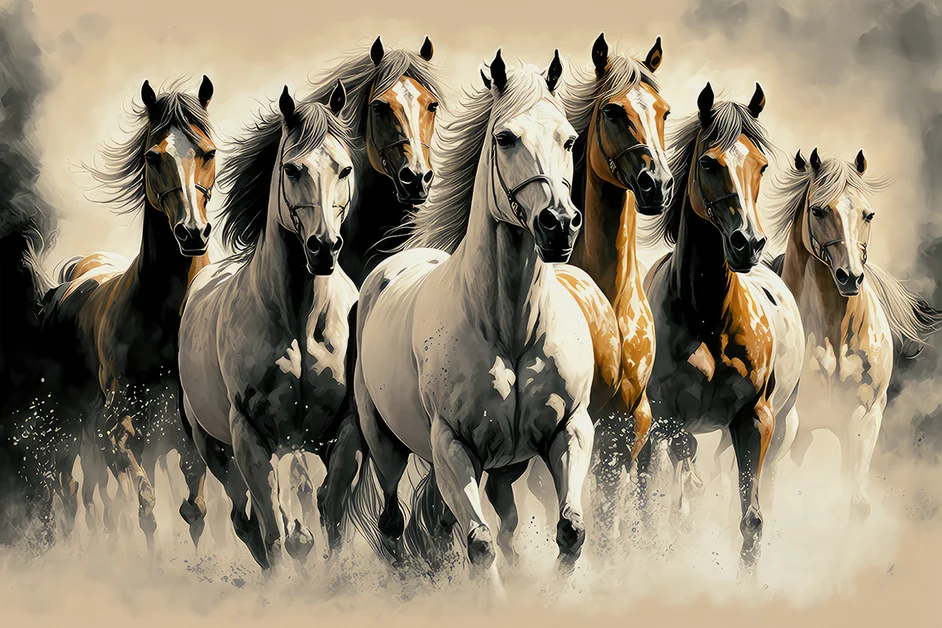
In Hindu tradition, seven horses pull the chariot of Surya Dev, the Sun God. Each horse represents one day of the week, so together they embody the full cycle of time, continuous progress, and unstoppable forward motion.
The number 7 itself carries deep meaning in Indian spirituality seven vows in a wedding, seven sages (Saptarishi), seven chakras. In Vastu, this sense of completeness is what makes the painting a powerful symbol rather than just decorative art.
The running horses together represent:
- Strength and momentum individually and as a unit
- Speed and progress movement without stagnation
- Fame and success alignment with solar energy
- Teamwork and loyalty horses are naturally social animals
One rule that most guides gloss over: the horses must appear to gallop into the room, not out of it. A painting where they face a wall, door, or window is considered inauspicious because the energy flows outward instead of inward.
Ideal Direction for the 7 Horses Painting
Direction is the single most important Vastu variable. Here's what each recommended wall actually does:
South Wall Best for career and recognition The south is associated with fame and public image in Vastu. This is the top choice for professionals, business owners, or anyone seeking visibility and advancement in their field.
North Wall Best for wealth and opportunity The north is governed by Kuber, the deity of wealth. Hanging the painting here is believed to attract financial growth, new career opportunities, and overall abundance.
East Wall Best for health and new beginnings The east is the direction of the rising sun naturally connected to Surya Dev. It works well for new ventures, improved health, and creative work.
What to avoid: West and southwest walls are generally not recommended for energetic, dynamic art like the 7 horses. These directions carry a heavier, more settling energy that conflicts with the forward movement the painting represents.
Colour Guide: Which Background Should You Choose?
The background colour shifts the painting's energy in a specific direction. Here's a practical breakdown:
Sunrise or orange background Connected to the Sun and ambition. Best for career growth; works well on the south wall.
Blue background Associated with Jupiter, wisdom, and calm. A good choice for peace of mind; suits the east or north wall.
White or grey background Linked to the Moon and clarity. Promotes harmony and emotional balance; best on the north wall.
Red background Connected to Mars and high energy. Suits people who want drive and motivation in their space.
Sea or night-sky background Associated with Saturn and endurance. Works well for stability-focused goals; suits the southeast wall.
On the horses themselves: white horses are the most traditional choice since they mirror Surya Dev's chariot. That said, coloured or multi-toned horses are equally valid in Vastu what matters more is the background, placement, and direction.
Where to Hang It and Where to Avoid
Good spaces:
- Living room the most ideal location in any home
- Home office or personal study
- Office reception or workspace
- Side wall of an entrance hallway (never directly facing the main door)
Spaces to avoid:
Bedroom The horses carry active, yang energy. The bedroom needs calm, receptive energy for rest. The two are opposites, and mixing them disrupts sleep and the room's purpose.
Bathroom or toilet Water-heavy spaces dissipate positive energy associated with the painting.
Pooja room The prayer room is reserved for devotional energy. Decorative art with symbolic power can create conflicting vibrations in this space.
Wall directly facing the main door Energy entering your home needs space to settle. A powerful painting directly opposite the entrance can push that energy back out.
Practical Tips Before You Hang It
- Hang at eye level roughly 5 to 6 feet from the floor so the energy interacts naturally with the people in the room.
- Make sure all seven horses are fully visible. A cropped or partially hidden horse breaks the symbolic completeness.
- Keep the surrounding wall clean and uncluttered. Vastu works on energy flow, and clutter blocks it.
- A well-lit painting carries more presence. Add a focused picture light above it if the area is dim.
- Choose a frame that fits your room's palette the painting should feel intentional, not like an afterthought.
- Dust and maintain it regularly. A neglected painting holds stagnant energy, which defeats the purpose entirely.
Common Myths Cleared Up
"The painting will bring instant wealth." No symbol replaces financial planning. The 7 horses painting is meant to support a growth-oriented mindset and environment not act as a substitute for practical effort.
"Placement doesn't really matter." It does significantly. Direction and positioning are the two most critical Vastu factors for this painting. An incorrect placement can actively work against the intended energy.
"Any 7 horses image will do." The horses should be depicted galloping freely not standing still, restrained, or in distress. The overall image should feel energetic and joyful. A dark, chaotic, or violent depiction carries opposite energy.
"Bigger is always better." Choose a size proportionate to your wall and room. An oversized painting in a small space creates visual imbalance the opposite of what Vastu aims to achieve.
"Once hung, no maintenance needed." A dusty, faded, or damaged painting carries stagnant energy. Clean it regularly, keep the frame in good condition, and replace it if it becomes damaged.
The Bottom Line
The 7 horses painting is a meaningful piece of Vastu art when placed with intention. The three things that matter most are direction (south, north, or east), orientation (horses facing inward), and condition (clean, complete, well-lit). Get those three right, and the rest is secondary.
Posted By
Akshay Gupta
info@houssed.com
Akshay Gupta writes about lifestyle and modern living for Houssed, focusing on practical décor ideas and everyday comfort. His work offers simple guidance to help readers create functional and welcoming home environments.