

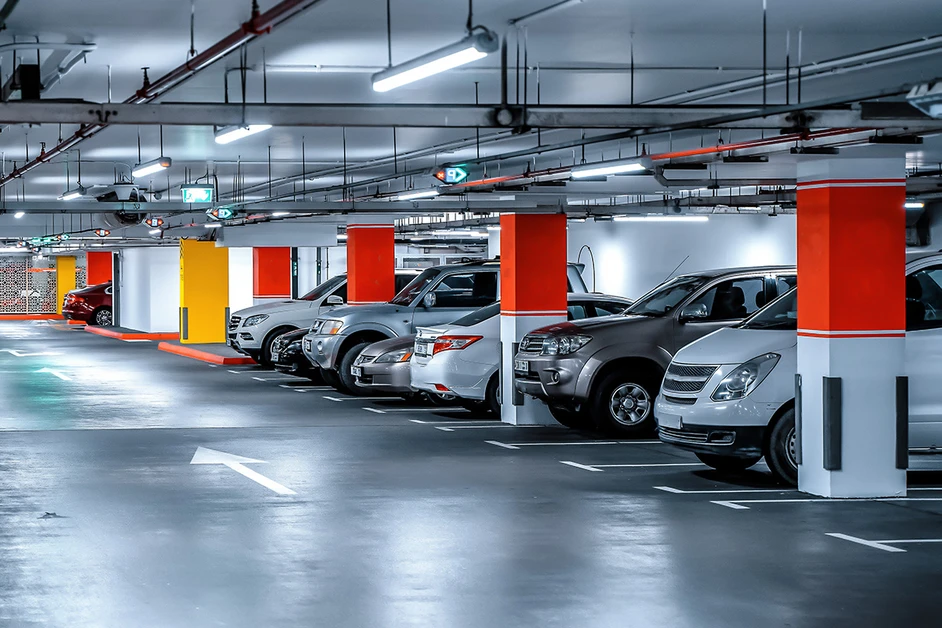
If you've ever circled an apartment complex's basement looking for a spot that's technically yours but somehow occupied by your neighbor's second car, you already know parking is one of the most quietly explosive issues in Indian housing societies. With more vehicles on the road every year and most new construction going vertical rather than horizontal, the math just doesn't work in everyone's favor.
But before you get into a shouting match with your RWA or sign off on a "covered parking charge" your builder has slipped into the agreement, it's worth understanding what the law actually says because it's more buyer-friendly than most people realize.
The Core Rule: Open and Stilt Parking Cannot Be Sold
This isn't a gray area anymore. The Supreme Court settled it back in 2010, in Nahalchand Laloochand Pvt. Ltd. vs. Panchali Co-operative Housing Society Ltd. The Court held that an open-to-the-sky parking spot or a stilt area used for parking doesn't meet the legal definition of a "garage." Because of that, it can't be sold as a separate unit not as a flat, and not bundled with one either.
The logic the Court used is worth knowing, because it cuts through a lot of builder justification, developers aren't losing money by not selling these spaces, since the cost of common areas and facilities is already built into what every buyer pays in proportion to their flat's carpet area. In other words, you've likely already paid for it once. Charging again is effectively double-billing.
RERA, which came into force in 2016, didn't overturn this, it reinforced it. Under RERA, open and stilt parking are explicitly treated as common areas that belong to all flat owners collectively, not as inventory the builder gets to sell off unit by unit.
The One Exception: Enclosed Garages
There's a narrow carve-out, and it trips a lot of people up. If a parking space is a genuinely enclosed structure walls on at least three sides, a roof, and a door or shutter that locks, it qualifies as a "garage" under the law and can be sold as an independent unit. The catch is that it has to be disclosed clearly as a garage in the sale agreement, not described loosely as "covered parking," and it must be registered as such with RERA. A stilt spot with a roof but no walls doesn't qualify, no matter what the brochure calls it.
So when a builder asks for extra money, the first thing to check is whether what's being sold is actually a fully enclosed garage or just open/stilt parking wearing a fancier name.
What Happens After Possession
Once the Occupation Certificate is issued and the society is formed, all open and stilt parking areas transfer to the society as common property. From that point on, the builder has no further say in how those spaces are allotted that authority sits entirely with the society's managing committee. If a developer has already sold spots to outside buyers or kept some aside to sell later, courts have repeatedly held that those sales become void once the society takes over, and the society can reallocate them.
This has played out in real disputes. In one widely discussed case, a developer who had sold stilt parking spaces to non-members faced objections from the society's own residents and the matter ended up in court precisely because residents pushed back on outsiders parking inside their compound.
Six Parking Problems Every Society Runs Into (and What Actually Works)
1. People parking extra vehicles without authorization
A flat owner is entitled to parking based on their unit size — typically one slot, sometimes two for larger units depending on local rules. Problems start when a second car shows up, whether it belongs to a spouse, a relative staying long-term, or a visiting friend, and it just gets parked wherever there's room.
What works: If your allotted space can reasonably fit an extra two-wheeler, get sign-off from the society's managing committee before treating it as permanent. For an additional four-wheeler, you'll typically need to pay an extra parking charge set by the society, and unauthorized parking can draw a fine under the society's bye-laws.
2. Tenants left without a clear spot
Renters often assume parking comes with the flat, and sometimes it doesn't.
What works: If the landlord has an allotted space, the lease should specify that the tenant gets to use it, owners are expected to pass that access along. If the landlord doesn't have parking rights to begin with, the tenant can't simply claim a spot; any arrangement has to go through the society, and is usually paid for by whoever benefits from it.
3. Guests being turned away at the gate
Even when a complex has visitor parking on paper, security staff sometimes wave delivery personnel and guests onto the street occasionally citing municipal pressure, sometimes just out of habit. This isn't a small inconvenience; vehicles parked outside the gate are at real risk of theft or damage.
What works: Under Mumbai's Development Control and Promotion Regulations (DCPR), visitor parking requirements have shifted over time, current municipal norms call for a minimum allocation for visitors as part of the sanctioned layout, with some zones requiring meaningfully higher shares. The number varies by location and project, so check your society's approved layout plan rather than assuming a flat percentage. Whatever the number, security staff should be briefed clearly so they're not making up their own rules at the gate.
4. A few residents hogging multiple spots In societies where parking is tight, some owners with two or three vehicles end up using more than their fair share, while single-car owners go without.
What works: Allotment is generally meant to be first-come, first-served among eligible members. Where extra spaces genuinely exist after every eligible resident has been given one space, societies can offer second or third spots but only once nobody else is waiting for their first.
5. No clear markings, constant confusion Open parking areas without painted lines or numbers turn into a free-for-all, and a few inconsiderate residents can make life difficult for everyone else.
What works: Society bye-laws require spaces to be marked and numbered, separately for two-wheelers and four-wheelers, so there's no ambiguity about whose spot is whose.
6. Simply not enough spaces to go around When the number of vehicles outpaces available slots, somebody is parking outside, every single day.
What works: Many societies resolve this with an annual lottery among eligible residents, or a rotation system so the inconvenience of parking outside is shared rather than falling on the same people every time.
Where the RWA Fits In
Your Residents' Welfare Association (RWA), formally registered under the Societies Registration Act, 1860 - is the body that actually administers parking once the builder is out of the picture. RERA requires that an RWA be formed within a set period after a project is registered, specifically so residents have a functioning body to take over common areas like parking.
A few things worth knowing before you take a parking complaint to your RWA:
- Common areas, including parking, belong to the society as a whole. Individual RWA office-bearers don't personally own or control these spaces.
- The managing committee allots parking based on the sanctioned layout plan approved by the local civic authority, it can't invent new spaces or rules that contradict that plan.
- Both flat owners and approved associate members can be part of the RWA's processes.
- If your committee issues entry stickers for registered vehicles, that's meant to speed up gate checks, not replace proper allotment records.
So, Should You Pay Extra for Parking?
For open or stilt parking: no, not legally. That cost is supposed to already be folded into your flat's price, and courts have been consistent on this for over a decade. For a genuinely enclosed garage, sold and disclosed as one, a separate charge is permitted.
If a builder is asking you to pay extra for what's clearly an open or stilt spot, that's worth pushing back on, and if needed, raising with your state's RERA authority. The framework exists precisely so that parking doesn't become a recurring fight between residents, or an extra line item builders can quietly add to your bill.
Disclaimer: This article is for general informational purposes and reflects publicly available legal rulings and regulatory provisions as commonly reported. Parking rules can vary by state and by each project's sanctioned layout plan, so for a dispute specific to your flat or society, it's worth confirming details with your local RERA authority or a property lawyer.
Posted By

Siddharth Jangam
info@houssed.com
Siddharth Jangam contributes to the Guides section at Houssed and works as a Digital Media Specialist focused on SEO and social media marketing. He shares insights that help readers understand India’s real estate market and buyer behavior.