

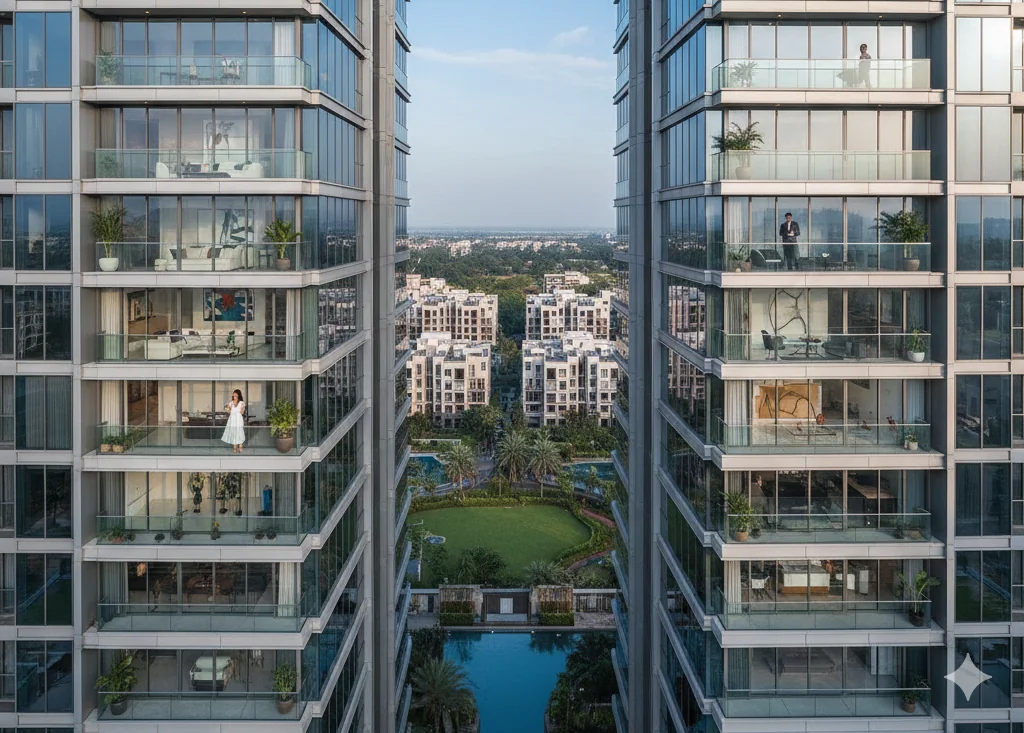
Walk into any Pune project and you’ll see it: identical floor plans, same tower, same viewline, except one flat costs ₹20–40 lakh more. This premium isn’t mystical; it’s a micro-decision of developers, brokers, and buyers to either exploit or ignore. If you’re buying, understanding these factors is your fastest route to smarter negotiation and true value.
1. Orientation and sun-wind corridors
Orientation dictates daylight, heat gain, and cross-ventilation. A flat facing west or a hot, unshaded eastern exposure can feel hot through March–June; buyers pay for cooler, well-ventilated units. In Pune, where summer heat and monsoon humidity matter, flats aligned to prevailing winds or shaded by trees/buildings command noticeable premiums, sometimes several lakhs, because they reduce future energy bills and improve comfort.
2. The good view” tax skyline, trees, or the neighbor’s wall
A balcony that looks over a green pocket, playground, or lake sells. A balcony that stares into another tower’s service shafts tanks value. Views change daily life: better light, privacy, and resale appeal. Developers price these with near-religious fervor. That “park-facing” tag is often a single line item that explains much of the ₹20–40 lakh gap.
3. Corner vs mid-unit: noise, windows and usable space
Corner apartments typically have more windows, better cross-ventilation, and less shared wall noise. They can have slightly larger usable layouts despite identical built-up areas. That livability bump is easy to monetize, especially for buyers who value daylight and airflow over glossy interiors.
4. Layout efficiency and usable carpet
Two flats can share the same super-built-up area but have very different usable (carpet) spaces. Long corridors, alcoves, and oversized balconies increase built-up numbers while shrinking usable living area. Builders price on built-up; savvy buyers price on carpet and functionality. A “₹1.1 crore” flat with poor usable space might actually be a worse deal than a cheaper, smarter-designed neighbor.
5. Parking, storage and utility spaces
Reserved basement parking, adjacent visitor slots, or an extra storeroom add tangible convenience. Developers may bundle these as add-ons or include them only with certain flats. For working families in Pune who own two cars or value storage, this convenience can justify lakhs in price difference.
6. Floor rise and perception premiums
Even on the same floor, some flats get “premium” tags because of micro-positioning: closer to the lift lobby (for convenience), farther from the trash chute (for smell), or on the quieter end of the corridor. Developers use subtle psychology: label a unit “premium,” and buyers behave as if it’s objectively better. Don’t fall for the perception map the actual trade-offs.
7. Sunshades, balconies and future utility
Large balconies that are usable year-round with sunshades or good drainage increase living area utility. A balcony that floods in monsoon or is too exposed to dust from a nearby road is effectively dead space. This difference in practicality gets capitalized into price.
8. Fittings, handover condition and snag history
Two flats may differ in what’s included: better sanitaryware, higher-grade flooring, or premium lifts serving a cluster of floors. Additionally, if a flat is in a stack that had fewer snag issues in typical developer handovers, it becomes more desirable. Buyers often overpay for “move-in ready” without calculating whether those fittings are still durable; the market prices that certainty.
9. Legal/structural quirks and intangible risks
Sometimes the premium hides risk: an encroachment on the common area, a disputed parking slot, or a pending sanction for a staircase. Risk-averse buyers will pay up to avoid legal hassle. Conversely, a cheaper flat might be discounted because of future litigation risk, a discount that can be a bargain if you do your legal homework.
10. Buyer personas and micro-markets
Price gaps also reflect who’s buying. A wing that attracts NRIs or executives may sell at higher rates than a wing favored by local investors. Rental yield expectations differ across wings; what one buyer calls “overpriced” another calls “prime.”
Buyer checklist: When two flats on the same floor have different prices
- Check usable carpet vs built-up area (don’t rely on developer math).
- Inspect orientation at peak sun hours and during monsoon.
- Compare balcony usability and drainage.
- Note the number and placement of windows for cross-ventilation.
- Ask what fittings are included and get brand names in writing.
- Verify the assigned parking and storage locations on the plan.
- Request a history of defect complaints for the block.
- Ask about any legal notices or disputed amenities.
- Compare proximity to the lift, lobby, trash chute, and common areas.
- If the price difference is large, ask the broker/developer to itemize why.
If a ₹20–40 lakh gap still feels mysterious after this checklist, it’s because you never asked the right questions. Developers price emotion and convenience and learn to convert both into measurable terms.
Posted By

Siddharth Jangam
info@houssed.com
Siddharth Jangam contributes to the Guides section at Houssed and works as a Digital Media Specialist focused on SEO and social media marketing. He shares insights that help readers understand India’s real estate market and buyer behavior.