

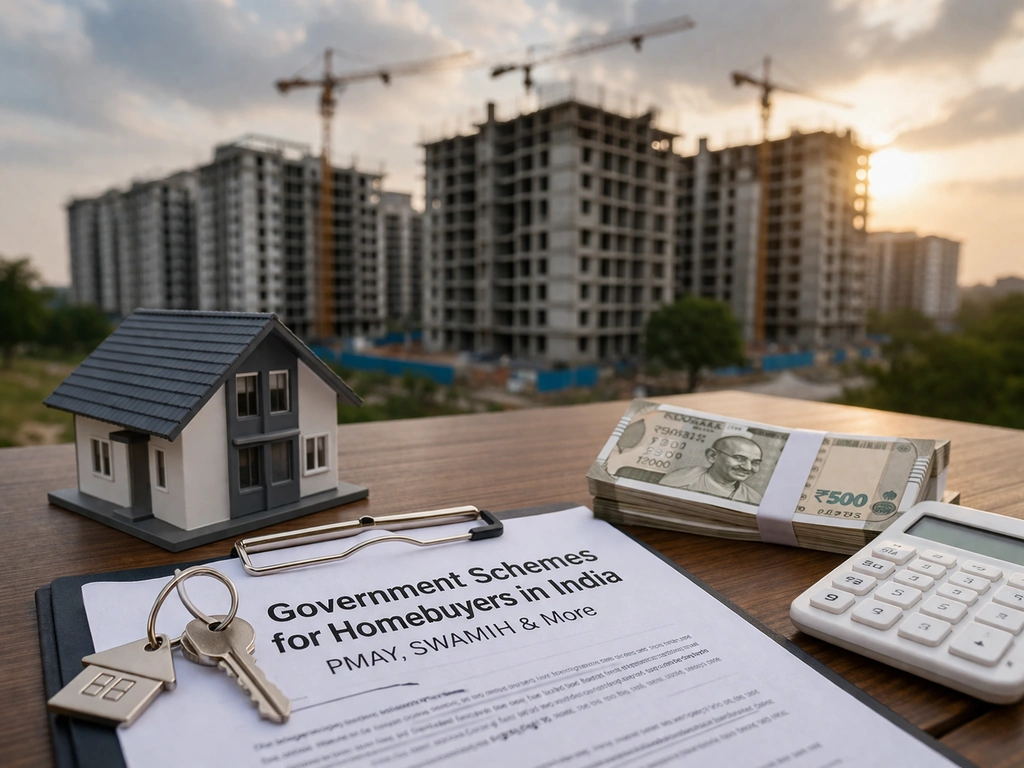
Buying a home in India is still financially challenging for a large section of buyers. To address this gap, the government has introduced multiple government schemes for homebuyers in India that aim to improve affordability, provide funding support, and revive stalled housing projects
1. Pradhan Mantri Awas Yojana (PMAY)
Pradhan Mantri Awas Yojana (PMAY), launched in 2015, is a government initiative providing affordable housing for all in urban (PMAY-U) and rural (PMAY-G) areas. PMAY-U 2.0 (2024-2029) supports constructing or buying homes for EWS/LIG/MIG segments, with up to ₹2.5 lakh aid.
Key Features:
- Interest subsidy up to ₹2.67 lakh
- Applicable under CLSS (Credit Linked Subsidy Scheme)
- Targets EWS, LIG, and MIG categories
- Applicable for urban and rural housing
If you're buying your first home and your income falls within defined brackets, this is the most practical subsidy available today.
A lot of buyers assume they’re eligible but miss out due to documentation errors or buying non-compliant projects.
2. SWAMIH Investment Fund
The SWAMIH (Special Window for Affordable and Mid-Income Housing) Fund is a government-backed, specialized investment fund (AIF) launched in 2019 to provide priority debt financing to distressed, stalled, brownfield, and RERA-registered housing projects.
What It Does:
- Focuses on stalled and stressed housing projects
- Helps complete last-mile funding gaps
- Targets middle-income and affordable housing projects
Why It Matters:
- Thousands of homebuyers were stuck paying EMIs without possession
- This doesn’t help you buy cheaper it helps ensure you actually get the house you already paid for.
3. Credit Linked Subsidy Scheme (CLSS)
The Credit Linked Subsidy Scheme (CLSS) under PMAY-Urban provides interest subsidies on home loans for EWS, LIG, and MIG categories to facilitate affordable housing.
Benefits:
- Subsidy of 3% to 6.5% home loan interest rates
- Reduced EMI burden
- Applicable across income groups (MIG included)
Many buyers don’t realize the subsidy is front-loaded, which means it reduces your principal upfront.
4. Affordable Housing Fund (AHF)
The Affordable Housing Fund (AHF), established in 2018-19 in the National Housing Bank (NHB) with an initial ₹10,000 crore, provides refinance assistance to Primary Lending Institutions (PLIs) for individual loans in rural and urban areas.
Role:
- Provides liquidity to developers
- Boosts supply of affordable homes
- Supports housing finance companies
Why You Should Care:
More funding = more supply = better pricing stability
5. State-Level Housing Schemes
State-level housing schemes in India, often implemented in conjunction with the central Pradhan Mantri Awas Yojana (PMAY), offer affordable housing through subsidies, lottery systems, and financial aid for EWS, LIG, and MIG groups. Apart from central policies, states run their own affordable housing schemes in India.
Examples:
- MHADA (Maharashtra)
- DDA Housing Scheme (Delhi)
- Tamil Nadu Housing Board
Advantage:
- Lower-than-market pricing
- Government-backed allocation systems
Demand massively exceeds supply. Winning a flat is often luck-driven.
What Most Buyers Get Wrong
- They assume subsidies are automatic (they’re not)
- They don’t check builder eligibility under PMAY
- They ignore stalled project risk (where SWAMIH becomes critical)
- They overestimate how much subsidy reduces actual cost
Should You Rely on These Schemes?
These government schemes for homebuyers in India are helpful but they’re not magic solutions.
- PMAY = Good for saving money
- SWAMIH = Good for reducing risk
- State schemes = Good if you get lucky
If your entire buying decision depends on subsidies, you're already making a weak financial move. Use these schemes as supporting tools, not the main reason to buy.
Posted By

Siddharth Jangam
info@houssed.com
Siddharth Jangam contributes to the Guides section at Houssed and works as a Digital Media Specialist focused on SEO and social media marketing. He shares insights that help readers understand India’s real estate market and buyer behavior.