

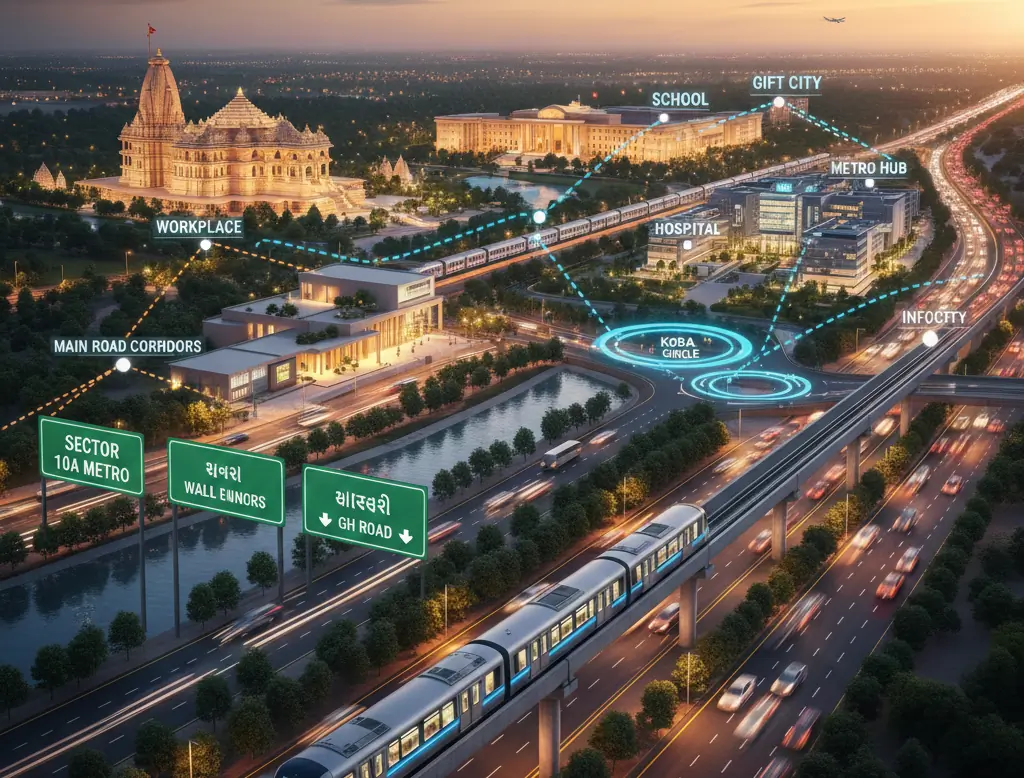
If this new year you are planning to buy a property, connectivity is your top filter while house-hunting in Gandhinagar; don’t just look. Which area is best? Look for:
Best connected to what?
- Your office (GIFT City / Infocity / Secretariat / Ahmedabad)
- Your child’s school route
- Railway station
- Bus routes
- Essential services
Connectivity in Gandhinagar is about predictability. Roads are wide, sectors are planned, and travel times are stable. Still, not all residential areas perform equally when it comes to daily travel efficiency. It's well-planned, with many decent sectors. But a few areas outperform because they are located in the central business district, on the main road, and near major landmarks.
How Gujarat Gandhinagar’s connectivity system actually works
CH Road & GH Road are Gandhinagar’s two primary internal backbones.
- If your sector opens directly onto either, your daily travel time drops noticeably.
- Sector-to-sector movement is slower than main-road movement due to internal loops and speed controls.
- Metro + road combo beats road-only living, especially for trips toward Ahmedabad or large institutions.
- Unlike metros, travel time variance is low; a 20-minute commute usually stays 20 minutes.
1. Sector 1 & Sector 10A area: Strongest public-transport access
If you want to live close to government offices and still stay connected city-wide, Sector 1 and the Sector 10A side are strong picks because they're located right on the Gandhinagar metro corridor.
Key metro stations in this stretch include Sector 1 and Sector 10A.
Gujarat Metro Rail: This matters because the same metro network also connects towards Motera Stadium (Ahmedabad side) and the key Gandhinagar hub.
Why this belt stands out
- Direct access to north–south metro corridor
- Immediate connection to central Gandhinagar without zig-zag sector travel
- Close to administrative zones and city-level facilities
- Walking or short-auto access to metro stations
- Quick Commute to Gandhinagar Capital railway station compared to outer sectors
- Bus frequency is higher here due to office-going population
- Easier cab availability (essential during early mornings or late nights)
2. Sachivalaya Akshardham Juna Sachivalaya zone
For many homebuyers, connectivity means one thing: quick access to secretariat/administrative offices without daily traffic stress. The metro stations Sachivalaya, Akshardham, and Juna Sachivalaya are located right in this area.
Also, the Phase II expansion has been increasingly opened GMRC notes the Motera–Mahatma Mandir and GNLU–GIFT City sections were inaugurated in September 2024, and the stretch up to Sachivalaya opened to the public in April 2025.
Connectivity
- Straight-road access to multiple government complexes
- Shortest response time for emergency services (hospitals, police, fire)
- Why families choose this zone
- No dependency on internal sector roads
- Predictable travel times even during official events
3) Sector 16 - Sector 24 – Mahatma Mandir belt
This area benefits from connectivity without congestion.
- Direct connection to central Gandhinagar and outer corridors
- Metro and road access without being stuck in office-heavy zones
- Easier navigation for guests and service providers
- Festive days increase movement temporarily, not permanently
- Roads here handle traffic better due to width and planned exits
- Ambulance and school-bus movement is smoother than inner sectors
On major festivals, traffic patterns can change. If you hate occasional crowd surges, choose a slightly interior area within the same location.
4) Koba Circle Tapovan Circle Narmada Canal stretch
If you have to frequently travel toward the Ahmedabad-side hub or institutional areas, the Koba/Tapovan side is the best location.
Metro stations listed along this line include
- Koteshwar Road
- Vishwakarma College
- Tapovan Circle
- Narmada Canal
- Koba Circle
Gujarat Metro Rail Connectivity advantages
- Quick Travel to Ahmedabad-Gandhinagar corridor
- Less internal sector driving
- Multiple route options (helps during roadblocks or diversions)
- Shorter airport travel time compared to central sectors
- Less dependency on peak-hour city traffic
Choose pockets a bit away from the circle itself to avoid constant through-traffic noise
5. Infocity - Raysan - Randesan side
This area suits well for people whose daily routine is tied up.
Connectivity
- Metro access aligned with institutional and work hubs
- Road layouts designed for continuous movement, not stop-start driving
- Better last-mile connectivity via autos and shared transport
Lifestyle
- Less internal sector delays
- Less fall back during daily errands
- Gandhinagar Capital Railway Station (Sector 14) is centrally located
- Living closer to CH Road reduces station access time significantly
- Sardar Vallabhbhai Patel International Airport is reachable without city-core congestion
- Western and northern areas save meaningful time on early-morning flights
- GSRTC depot in Sector 11 quickens intercity bus movement
Final decision framework
When looking for the best connectivity, examine three things:
Exit test: How long it takes to leave your sector and hit a main road.
Peak-hour test: Check movement at your actual commute time, not midday.
Important triangle test
Measure distance/time to:
- workplace or daily destination
- nearest metro or main road
- hospital or school
If all three are organized, you’ve chosen a well-connected residential area.
Posted By

Siddharth Jangam
info@houssed.com
Siddharth Jangam contributes to the Guides section at Houssed and works as a Digital Media Specialist focused on SEO and social media marketing. He shares insights that help readers understand India’s real estate market and buyer behavior.