

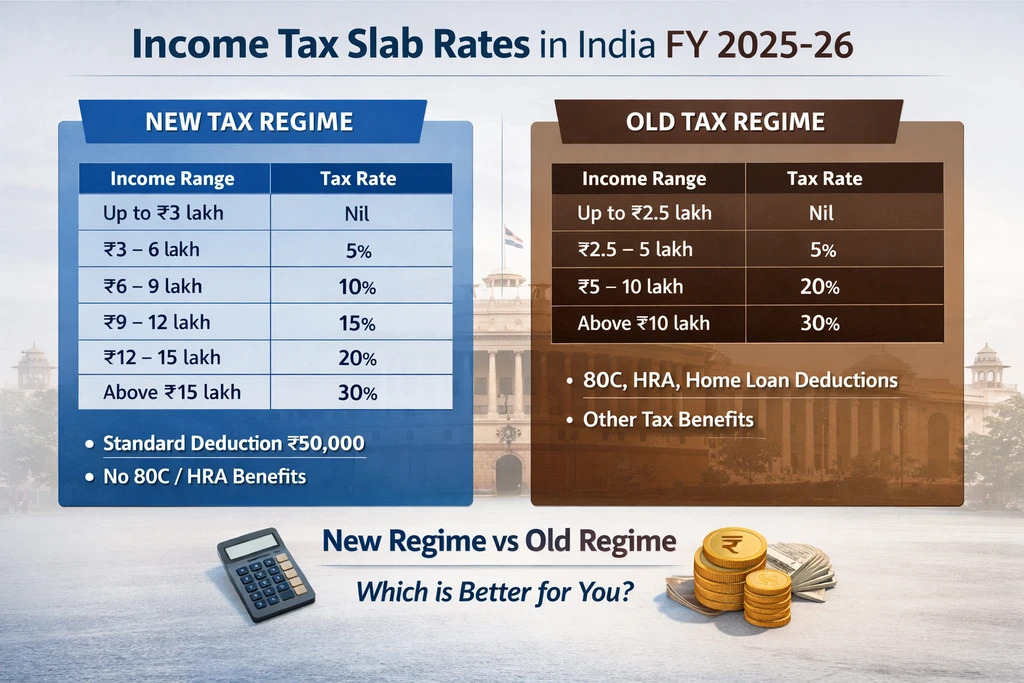
With the income tax slab rates for FY 2025-26, taxpayers once again face a critical choice between the old and new tax regimes. While both offer distinct advantages, the right option depends entirely on your income structure, deductions, and financial habits.
What Are Income Tax Slabs?
Income tax slabs are predefined income ranges on which different tax rates are applied. The more you earn, the higher the rate.
India currently offers two tax regimes:
- New Tax Regime (default): Lower tax rates, fewer deductions
- Old Tax Regime: Higher tax rates, but allows multiple deductions
Income Tax Slabs Under New Tax Regime (FY 2025–26)
The new tax regime is now the default option. It’s designed for simplicity, but simplicity doesn’t always mean savings.
Latest Slabs:
| Income Range | Tax Rate |
|---|---|
| Up to ₹3 lakh | Nil |
| ₹3 lakh – ₹6 lakh | 5% |
| ₹6 lakh – ₹9 lakh | 10% |
| ₹9 lakh – ₹12 lakh | 15% |
| ₹12 lakh – ₹15 lakh | 20% |
| Above ₹15 lakh | 30% |
Key Highlights:
- Standard deduction: ₹50,000 available
- Rebate under Section 87A: Up to ₹7 lakh income = zero tax
- No major deductions like 80C, HRA, LTA
This regime works well only if you don’t invest much or don’t claim deductions.
Income Tax Slabs Under the Old Tax Regime
This is the traditional system, more complicated, but potentially more rewarding if used correctly.
Slabs:
| Income Range | Tax Rate |
|---|---|
| Up to ₹2.5 lakh | Nil |
| ₹2.5 lakh – ₹5 lakh | 5% |
| ₹5 lakh – ₹10 lakh | 20% |
| Above ₹10 lakh | 30% |
What You Get:
- Section 80C (₹1.5 lakh deductions)
- HRA benefits
- Home loan interest deduction
- Medical insurance (80D)
- LTA and more
New vs Old Tax Regime: The Real Difference
| Factor | New Regime | Old Regime |
|---|---|---|
| Tax Rates | Lower | Higher |
| Deductions | Very limited | Multiple |
| Complexity | Simple | Complex |
| Best For | Low deductions | High deductions |
Which Tax Regime Should You Choose?
Choose the New Regime if:
- You don’t invest much
- You don’t claim HRA
- You want a simple filing process
- Your deductions are less than ₹2–3 lakh
Choose the Old Regime if:
- You actively invest under 80C
- You pay home loan EMIs
- You claim HRA and insurance deductions
- Your total deductions exceed ₹3 lakh
Example: Tax Calculation for FY 2025–26
Let’s say your annual income is ₹10 lakh.
Under New Regime:
- Taxable income after standard deduction = ₹9.5 lakh
- Approx tax = ₹75,000 – ₹90,000
Under Old Regime (with ₹2.5 lakh deductions):
- Taxable income = ₹7.5 lakh
- Taxes = significantly lower
The old regime wins only if you actually use deductions properly.
Major Deductions Available in the Old Regime
- Section 80C: ELSS, PPF, LIC (₹1.5 lakh)
- Section 80D: Health insurance
- Home Loan Interest: Up to ₹2 lakh
- HRA: Based on salary + rent
- NPS (80CCD): Additional ₹50,000
Common Mistakes People Make
1. Choosing the default regime without calculation
This is the biggest mistake. Default doesn’t mean optimal.
2. Not investing to save tax
People complain about taxes but don’t claim deductions.
3. Ignoring HRA and home loan benefits
These can drastically reduce taxable income if you actually claim them.
4. Last-minute tax planning
If you start in March, you’ve already lost half the game.
Also Read: Smart Tax Strategies for Property Investors to Maximize Returns
Pro Tips to Reduce Your Tax Legally
- Start tax planning at the beginning of the financial year
- Use full 80C + NPS benefits
- Combine insurance and investment smartly
- Calculate both regimes before filing every year
Final Thoughts
If you’re just picking a tax regime without running the numbers, you’re doing it wrong.
The new tax regime is convenient but not always efficient.
The old tax regime is powerful but only if you actually use it.
Most people don’t lose money because of high taxes.
They lose money because they don’t understand how taxes work.
Posted By

Keerthi Choxsi
info@houssed.com
Keerthi Choxsi writes about property law and real estate regulations for Houssed. She explains legal frameworks, documentation requirements, and ownership rights to help buyers and investors understand property laws in India.