

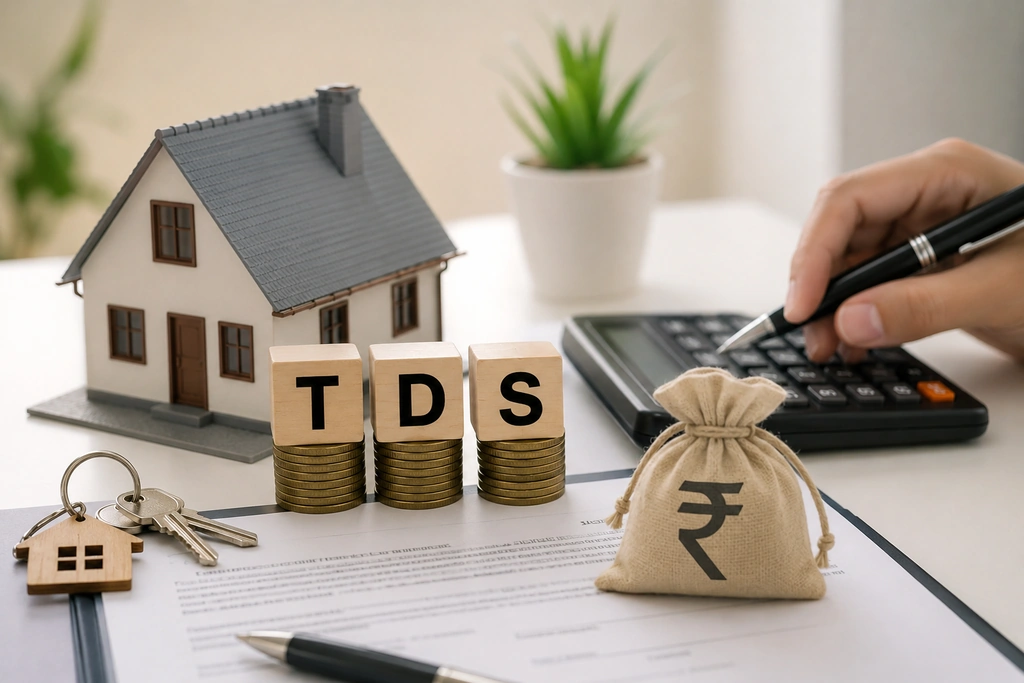
Buying property in India comes with a quiet little obligation that catches a lot of first-time buyers off guard: you, the buyer, are responsible for deducting tax before you even pay the seller. Not your bank, not the builder, not the registrar's office. You.
This is TDS - Tax Deducted at Source and if you skip it, the penalties land on your desk, not the seller's. Here's what it actually involves, what changed recently, and how to get it right without losing sleep over it.
What TDS Actually Means Here
TDS is the government's way of collecting tax in real time instead of waiting for the seller to declare it at the end of the year. You've probably seen this already with your salary - your employer holds back a portion and deposits it with the tax department on your behalf, and you get the rest.
The same logic applies when you buy property. The money you pay the seller counts as their income, and that income is taxable. So instead of trusting everyone to report it correctly later, the law makes you, the buyer, hold back a slice of the payment and deposit it directly with the government. The seller gets credit for that amount when they file their own return.
When You're on the Hook for TDS
Under what's commonly known as Section 194-IA (now carried forward as Section 393(1) [Table: Sl. No. 3(i)] of the Income-tax Act, 2025, for transactions from 1 April 2026 onward, confirmed on the Income Tax Department's own site), the rule is straightforward:
If you'd like a deeper breakdown of how Section 194-IA works, including eligibility conditions, filing requirements, and common compliance mistakes, see our detailed guide on the 194IA of the Income-tax Act.
If the property value is ₹50 lakh or more, deduct 1% as TDS.
This covers residential property, commercial property, and land but not rural agricultural land, which sits outside this rule entirely.
One change worth knowing: since the Budget 2024 amendment took effect, TDS isn't calculated on whatever figure is written in the sale agreement alone. It's calculated on whichever is higher, the agreement value or the stamp duty value assessed by the local authority. If your flat is priced at ₹48 lakh but the stamp duty valuation comes in at ₹52 lakh, TDS still applies, because the threshold is checked against the higher number.
If the property is under ₹50 lakh by both measures, you don't need to deduct anything.
Who Pays It - and Who Doesn't
The buyer deducts and deposits TDS. Full stop. It's a statutory duty, not a courtesy, and the seller has no say in whether it happens.
That said, you're not handing this money to the seller directly. It goes straight to the government, and the seller later claims credit for it through Form 26AS or the equivalent statement when filing their own tax return. If you're buying from a builder, many developers will guide you through the paperwork since they deal with this constantly but the legal responsibility still sits with you.
Joint Buyers and Joint Sellers
A point that trips people up: if a property is co-owned, the ₹50 lakh threshold is checked against the total property value, not each person's individual share. Two buyers splitting a ₹60 lakh flat 50-50 can't argue their ₹30 lakh share falls under the limit — TDS still applies because the property as a whole crosses ₹50 lakh.
How and When to Deposit TDS
TDS gets deducted either when you execute the sale deed or when you make an advance payment toward the property, whichever comes first. You then have 30 days from the end of the month in which the deduction happened to deposit it with the government.
Example: if you pay your seller in February, your TDS deposit deadline is the end of March.
If the total sale value is paid in instalments, TDS applies to each instalment separately, however small.
The paperwork: Form 26QB, and what's replacing it
Until now, this has meant filing Form 26QB through the NSDL/TIN portal, a combined return-cum-challan that doesn't require a TAN (Tax Deduction Account Number); your PAN is enough for resident-seller transactions.
This is changing. Under the Income-tax Act, 2025, Form 141 replaces Form 26QB for transactions where payment or credit happens on or after 1 April 2026. If your transaction's payment date falls before that, the old Form 26QB process still applies. Either way, the core steps are similar:
- Go to the official TIN portal (or its updated equivalent) and select the relevant TDS-on-property form.
- Enter buyer and seller details - PAN, Aadhaar, address, and contact information.
- Add the property details: full address, agreement date, total consideration, and stamp duty value.
- Review everything carefully - once submitted, you can't edit the form, only file a correction request later.
- Pay through net banking and save your acknowledgment number.
After payment, you're required to issue a TDS certificate to the seller - previously Form 16B, now Form 132 under the new framework, generally within 15 days of filing.
Buying From an NRI Seller: A Different Rule Entirely
This is where the old advice floating around the internet (including older versions of this very article) tends to get it wrong. Buying from a Non-Resident Indian seller does not fall under the 1%-above-₹50-lakh rule. It falls under Section 195, and it works differently in three important ways:
- No threshold. TDS applies regardless of property value - even a ₹10 lakh deal requires it.
- No flat rate. Unlike the simple 1% for resident sellers, the rate depends on the seller's actual capital gains tax liability. For long-term gains (property held over 24 months), the applicable rate is currently 12.5% (without indexation), following the Budget 2024 rate cut from the earlier 20%. Short-term gains are taxed at slab rates. Surcharge and a 4% health and education cess apply on top.
- Different form. Reporting goes through Form 27Q, not 26QB or 141.
A recent Budget 2026 update has also simplified the process slightly, buyers can now deposit this TDS using their PAN instead of first obtaining a TAN, which used to be a mandatory extra step.
Because the rate isn't fixed, many NRI sellers apply for a Lower or Nil Deduction Certificate (Form 13, under Section 197) to bring the TDS down closer to their actual tax liability instead of having a large chunk withheld upfront. If your seller has one, follow the certificate's specified rate instead of the default.
| Resident Seller (Sec 194-IA / 393) | NRI Seller (Sec 195) | |
|---|---|---|
| Threshold | ₹50 lakh or more | None - applies to any value |
| Rate | 1% flat | 12.5% (LTCG) or slab rate (STCG), plus surcharge & cess |
| ID needed | Buyer's PAN | PAN (TAN previously required) |
| Form | 26QB (Form 141 from FY2026-27) | 27Q |
| Certificate to seller | Form 16B (Form 132 from FY2026-27) | TDS certificate via Form 27Q filing |
What Happens If You Get It Wrong
Missing or mishandling TDS isn't a minor slip, the penalties stack up:
- Late filing fee: ₹200 per day under Section 234E until you file, capped at the TDS amount itself.
- Interest for not deducting: 1% per month under Section 201(1).
- Interest for deducting but not depositing: 1.5% per month under Section 201(1A).
- Penalty for non-compliance: up to ₹1 lakh (minimum ₹10,000) under Section 271H.
- In serious cases of non-deposit: prosecution under Section 276B, with imprisonment ranging from 3 months to 7 years, plus a fine.
None of this is designed to trap honest buyers - it's there to discourage deliberate evasion. But it does mean the 30-day deadline isn't one to treat casually.
A Few Things Worth Double-Checking
- TDS is calculated on the full property value, not just the portion above ₹50 lakh.
- You'll need the seller's PAN for the filing - if they don't provide it, the TDS rate jumps to 20%.
- Quoting Aadhaar details is now part of the standard filing requirement.
- Extra charges like clubhouse fees, parking, or maintenance that are part of the sale agreement are included in the TDS calculation, don't accidentally exclude them.
- Double-check the seller's PAN before submitting. An error here means the seller can't claim credit for the tax you've already deducted on their behalf.
The Bottom Line
TDS on property purchase isn't an extra tax you're paying out of pocket, it's a portion of the seller's payment that you're routing to the government instead of handing over directly. Done correctly, it costs you nothing beyond a bit of paperwork; done late or incorrectly, it can mean real penalties and a frustrated seller who can't claim their tax credit.
With the shift from Form 26QB to Form 141 underway in 2026, it's worth checking which form applies to your specific transaction date before you file. And if you're buying from an NRI seller, throw out the old "flat 20%" assumption, the real number depends on the seller's capital gains, and it's worth getting a tax professional involved to calculate it accurately.
This article is for general informational purposes and reflects rules as understood in mid-2026. Tax provisions change with each Budget cycle - for a transaction-specific calculation, it's best to consult a chartered accountant or tax advisor.
Posted By

Keerthi Choxsi
info@houssed.com
Keerthi Choxsi writes about property law and real estate regulations for Houssed. She explains legal frameworks, documentation requirements, and ownership rights to help buyers and investors understand property laws in India.